Showing posts with label Society. Show all posts

Thursday, March 29, 2012

Increasing conformity in geekdom

Source: http://myextralife.com/56geeks/
A geek used to be a person who had a strong particular interest (that was often not shared by many others). However, as "geekness" has become more mainstream (and acceptable), the understanding of what constitutes a geek became more uniform (See The Evolution of Geek):


A geek must love science fiction (ALL science fiction, but especially Star Wars and Star Trek). A geek must like fantasy books and movies (ALL of them). A geek must read and collects comics books. A geek must have numerous collectibles in his room and office. A geek must play role playing games (both tabletop and online). A geek must be into cosplay and attend conventions (such as ComiCon and DragonCon). 


Daljeet Singh from the "Geeks are sexy" blog wrote an interesting personal reflection of how the geek community started to outcast geeks who do not show interest for that whole "geek package". Read more here: I’m a Geek…and I Don’t Like Star Wars

I agree with Daljeet's observations. Geeks identify themselves by a particular interest and often had to endure being social outcasts for their passions. It would be ironic if the geek community would outcast fellow geeks for not being geeky enough.

Thursday, January 19, 2012

The Meta-Geek

Copyright Scott Johnson: http://www.flickr.com/photos/scottjohnson/1190004360/ 

With geek culture becoming more mainstream, a novel form of geek emerges - the meta-geek.

A "meta-geek", or "geek geek", is fascinated with geek culture without being deeply involved in any one sub-culture. Meta-geeks are geeks about geek culture itself.

For example:

  • A meta-geek can follow geek-related blogs and watches videos from geek-related events (such as Comic-Con, Dragon-Con, or Star Trek conventions) without going there in person.
  • A meta-geek can be knowledgeable about comic characters without reading comics themselves. 
  • A meta-geek can blog about other geek cultures (for example, see Geek hierarchy chart and Evolution of geek) or read geek-related blogs (for example Geeksaresexy.net or Geekosystem.com).

Wednesday, November 24, 2010

Internet Access Divide between Rich and Poor Persists (PEW survey)


Not very surprising findings from a PEW survey: Wealthier households have more often a broadband internet access then less-wealthy households.


The digital divide continues to exist, even though broadband Internet has been widely available for over ten years. The study found that while 95% of households earning $75,000 or more use the internet in some way, just 57% of households earning $30,000 or less do so. 87% of users in the income top bracket have Internet in their homes, but just 40% of the lowest bracket do.


On the other hand, game consoles are almost equally common: 54% of those living in higher-income households own game consoles, compared with 41% of those living in less well-off homes.


iPads are still luxury products: 9% of those living in higher-income households own tablet computers such as iPads, compared with 3% of those living in less well-off homes.


Online news services are the main source of information next to television, especially for higher income households (74%) compared to low income families (34%).
To reduce the digital divide between households, affordable broadband internet services are needed.

Read the full results of the survey here: The Better-Off Online - Pew Research Center

Tuesday, November 23, 2010

Deconstructing Disney Princesses

by Beat A Schwendimann

Even the Disney Coorporation realized that their pretty-damsel-in-distress-waiting-for-a-prince model of princesses became less and less appealing to current young girls. The latest Disney movie, Tangled, tries to update the image of the princess by making her a stronger self-confident character.
Image from Disney movie "Tangled"
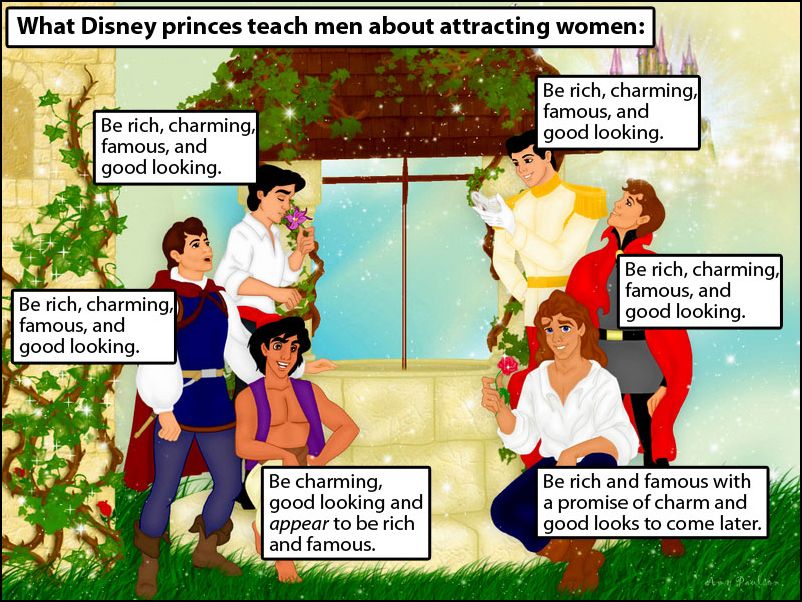
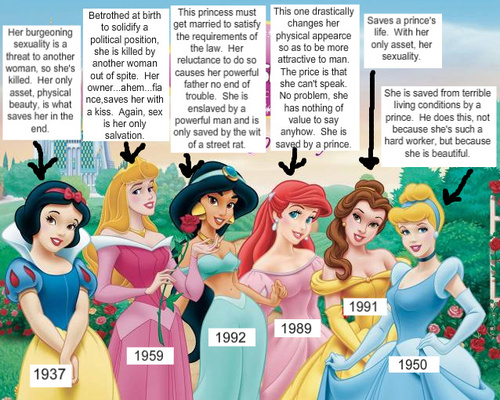
Disney princesses used to be (and maybe still are) role models for many young girls. However, the classic Disney princess presents an outdated stereotypical role model from the past (compare the two pictures below).


This youtube video discusses the gender stereotypes in Disney movies.


Among current girls, princesses and the romanticized ideal they represent — revolving around finding the man of your dreams — have a limited shelf life. With the advent of "tween" TV, the tiara-wearing ideal of femininity has been supplanted by new adolescent role models such as the Disney Channel's Selena Gomez and Nickelodeon's Miranda Cosgrove. "By the time they're 5 or 6, they're not interested in being princesses," said Dafna Lemish, chairwoman of the radio and TV department at Southern Illinois University and an expert in the role of media in children's lives. "They're interested in being hot, in being cool. Clearly, they see this is what society values." (Read full article in the L.A. Times on how Disney is closing the book on classic fairytale characters).

In Fallen Princesses, artist Dina Goldstein took a modern look at the life of a Disney princess by placing her in an environment that accentuates her conflict. The "Happily ever after" is replaced with a more realistic outcome and adresses current issues:

How about the life of a real princess? The life of a real princess does not seem to be much of a fairytale. This article by the Daily Beast: Kate's Royal Prison  describes the life that expects Kate Middleton as the wife of Prince William. Besides having no more private life or being able to say anything original, she is expected to be picture perfect for the rest of her life, every single minute will be monitored and discussed at large in the press. Each of her actions will constantly be compared to those of Queen Elisabeth and Princess Diana. I don't think many young girl would want to become a princess if they would know what it actually entails.

At least Disney princesses can have some fun (Prince Charming optional):

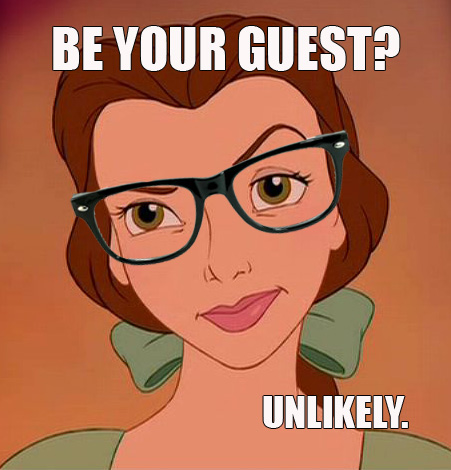
Or Disney princesses can be hipsters:
http://www.geekosystem.com/hipster-disney-princesses/
Click here to see the collection of hipster Disney princesses.

Disney animators found a cheap way to create new princess characters: They just clone existing ones:

Disney characters as more realistic drawings:
Jasmine in real life (by Jirka Väätäinen)

Disney characters might look like this in real life:
Rapunzel (from Tangled)